

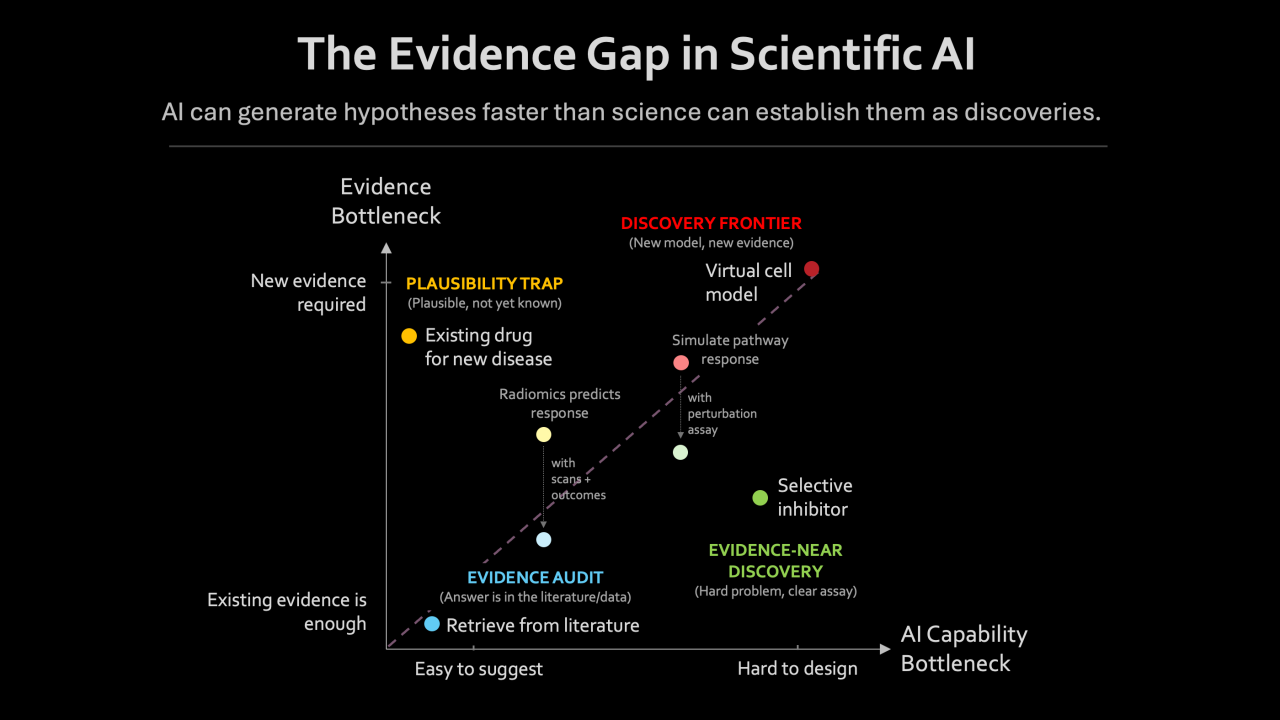
One reason AI has progressed so quickly is that many tasks are easier to verify than to solve. Jason Wei calls this the asymmetry of verification. Writing a correct program is difficult, but running its test suite is comparatively easy. Finding a mathematical proof may take months, while checking a candidate proof is often much faster. When candidate solutions can be evaluated cheaply, objectively, and at scale, verification becomes a powerful signal for training and iteration.
What is the analogue of verification in science?
Scientific hypotheses are not established by proof in the mathematical sense. They are shaped by evidence. A single experiment can strengthen our confidence, weaken it, narrow the conditions under which a claim applies, or suggest a different explanation altogether. Every result comes with assumptions, measurement limits, experimental design choices, and the possibility that future evidence will change today's conclusion.
Science, in other words, does not simply verify hypotheses. It updates our belief in them as evidence accumulates.
The task shifts from verification to evidence assessment
Not every part of scientific reasoning is equally verifiable. Checking whether a cited paper reports a particular finding is often straightforward. We can often determine whether a known contradictory study was ignored, what hypothesis was tested, or whether the reported statistics support the conclusion. These are questions about the evidence already available.
Other questions are fundamentally different. Is this the best biological explanation? Are we missing a competing mechanism? Is this drug target actually causal in disease rather than merely correlated with it? These questions cannot be resolved by inspecting the current evidence alone. They require generating new evidence, sometimes through years of experiments, replication, animal models, clinical studies, or failed attempts that never make it into a paper.
The difference is not simply difficulty. It is verification cost. Some claims can be assessed in minutes because the relevant evidence already exists. Others require creating the evidence needed to assess them. As AI makes hypothesis generation cheaper, the scarce resource shifts from ideas to evidence.
This is why the recent move from “AI that reads science” to “AI that participates in science” matters. Anthropic describes Claude for Life Sciences and Claude Science as efforts to make Claude useful across scientific workflows, with connectors to tools such as PubMed, Benchling, and scientific computing environments. Coscientist, an earlier GPT-4-based system, showed that an LLM-driven agent could plan and execute chemistry experiments through laboratory automation. These examples are early, but they point to the same bottleneck: once models can propose many plausible paths, the hard part becomes deciding which evidence is worth acquiring.
The way we verify knowledge determines how we should represent it
In domains where verification is effectively binary, representing knowledge as facts works well. A theorem is proven or not. A test passes or fails. A Sudoku solution satisfies the constraints or it does not. The representation can be clean because the evaluation is clean.
Much of science is not like that. Scientific knowledge is built from many kinds of evidence: papers, experiments, observational studies, clinical trials, databases, lab notebooks, expert judgment, negative results, computational predictions, and informal knowledge shared inside teams.
Each source has a different status. A randomized trial is not the same kind of evidence as a mechanistic hypothesis. A preprint is not the same as a replicated finding. A Slack message from a scientist who just ran an assay is not a paper, but it may still matter to the next decision.
This means uncertainty enters the scientific pipeline at many layers. The original experiment may be noisy. The paper may overstate the result. The extraction from the paper may be wrong. The knowledge graph may connect two entities too strongly. The model may reason from incomplete evidence. The next experiment may fail for reasons unrelated to the hypothesis. These uncertainties should not collapse into one generic confidence score.
A better representation is a belief state. A belief state is a scientific claim together with the evidence that supports it, the evidence that contradicts it, the provenance of that evidence, the uncertainty attached to each source, and the kinds of future evidence that would change the belief. It is not just “claim plus confidence”. It is a structured memory of why the claim is currently believed.
Beliefs over knowledge
Knowledge and belief are not the same thing. Literature is knowledge. A database entry is knowledge. A lab result is knowledge. But what a scientist believes after reading all of it is something else.
Scientists maintain beliefs over knowledge. They know which papers are central, which results are fragile, which mechanisms are plausible but unproven, which claims are mostly settled, and which conclusions depend on one weak experiment. Their expertise is not only in remembering the literature. It is in knowing how much weight to give each piece of it.
Scientific agents may need the same separation. The knowledge layer stores papers, experiments, entities, protocols, datasets, and relationships. The belief layer stores the current interpretation of that knowledge. When new evidence arrives, the agent should not simply overwrite the old claim. It should update the belief state.
This is where the Bayesian flavor becomes natural, without requiring the model itself to be Bayesian. The transformer can remain a transformer. The memory can still behave like an evolving belief system. The important shift is not Bayesian neural networks. It is Bayesian knowledge management: maintaining beliefs over evidence as the evidence changes.
What this means for scientific agents
If scientific agents are going to participate in discovery, memory cannot just mean storing useful facts for later retrieval. It has to mean maintaining the current state of belief across a changing evidence landscape. The question is not only “what do we know?” It is “why do we believe it, how strongly, and what would change our mind?”
Evaluation changes too. In verifiable domains, we often ask whether an answer is correct. In scientific domains, we may need to ask whether an agent updated its belief appropriately after seeing new evidence. Did it give too much weight to a weak study? Did it ignore contradictory evidence? Did it treat a computational prediction as if it were an experimental result? Did it distinguish between absence of evidence and evidence of absence?
This is the center of the problem. Verification does not disappear in science, but it becomes uneven, costly, and evidence-dependent. Some things can be checked. Some things can only be estimated. Some things require new experiments. Some things should remain open until better evidence exists.
The next generation of scientific agents may not be distinguished by generating better hypotheses. They may be distinguished by how well they maintain belief as evidence evolves.